How can a turned-off phone be harmful? Yes, this is not a typo)) We all know that smartphone addiction is dangerous for our mental health (increased anxiety, etc.), physical health (sedentary lifestyle), and social health (deterioration of relationships). But it is important to remember that even a turned off phone can have a negative impact on our cognitive abilities and our relationships.

Scientists call this the “mere presence effect”. When a phone is within sight (even if it is upside down), it still leads to us expending additional cognitive resources on it (thinking about who might have messaged or liked something, resisting the temptation to check it, etc.). All of this leaves fewer cognitive resources available for other tasks. Therefore, in studies, participants perform worse on tests of learning, memory, and attention when a phone is within sight compared to when a notebook is within sight.
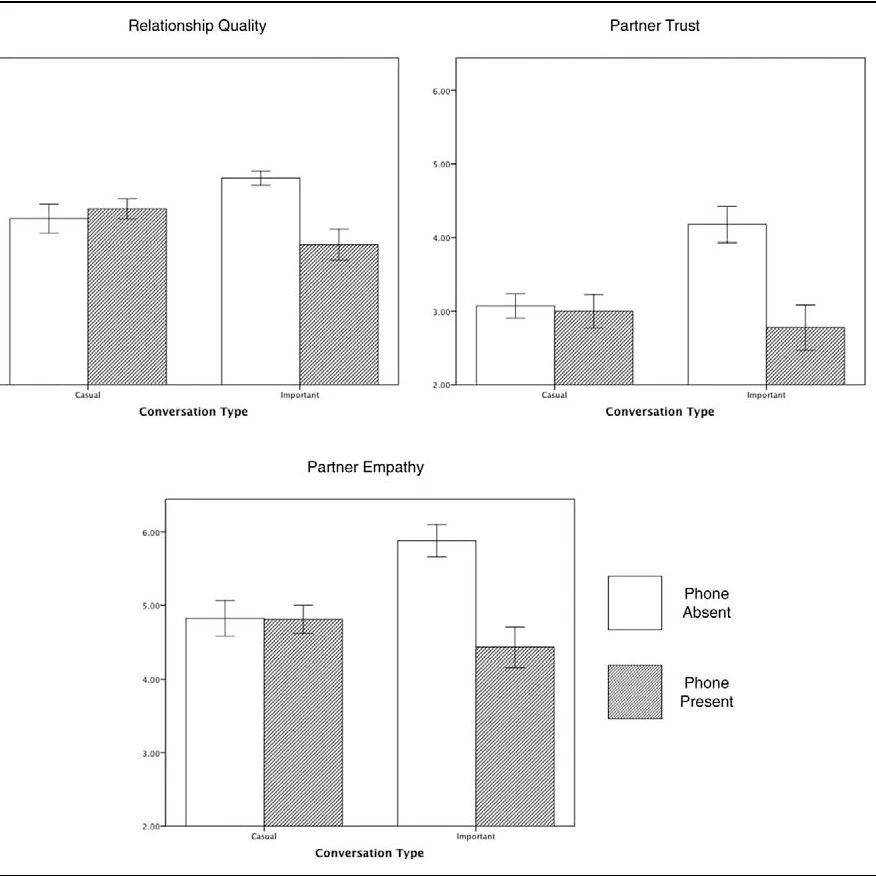
When we talk to people, the presence of a phone (even a turned off one) also leads to a lower quality of communication. Intimacy, significance, trust, and empathy all decrease. The closer the conversation partner and the more important the conversation, the greater the negative impact on communication quality. The possible mechanism is cognitive distortion, which impairs our ability to reflect on and understand the conversation partner, or frequent diversion of our gaze to the phone. Simply glancing at the phone for a second breaks eye contact and can reduce the release of oxytocin, which impairs the feeling of connection between conversation partners.
So, what should you do?
- Understand that the mere presence of a turned-off phone already affects your behavior.
Those who suffer more from smartphone addiction benefit from its absence from sight.
2. A phone in silent mode, upside down, or turned off (but within sight) does not work. It is better to keep it in a bag or drawer, but it is even better not to have it in the room at all.
3. Keeping the phone out of sight can have very positive effects on your cognitive abilities and improve the quality of communication. Do not touch your phone during conversations.
Mobile phones: The effect of its presence on learning and memory PLoS One. 2020; 15(8): e0219233.
PLoS One. 2020; 15(8): e0219233. Mobile phones: The effect of its presence on learning and memory
Brain Drain: The Mere Presence of One’s Own Smartphone Reduces Available Cognitive Capacity
Can you connect with me now? How the presence of mobile communication technology influences face-to-face conversation quality Journal of Social and Personal Relationships 30(3)
How bad is the mere presence of a phone? A replication of Przybylski and Weinstein (2013) and an extension to creativity PLoS One. 2021; 16(6): e0251451.
The iPhone effect: The quality of in-person social interactions in the presence of mobile devices. Environ Behav. 2016. Feb;48(2): 275–298.