Shatapawali.
Take a walk after each meal
Doctors in various cultures have come to the same advice of walking after meals (although they explained it differently). In Ancient China, a proverb advised “Fan hou bai bu zou, huo dao jiu shi jiu,” meaning take 100 steps after eating if you want to live until 99 years old. In India, there even existed a specific term — shatapawali (Shatapawali), which literally means “hundred steps” (after eating).
And Hippocrates wrote, “Walking after dinner dries the belly, reduces the accumulation of fat in the abdomen (visceral fat).” In Italy, this is called passeggiata — a leisurely walk for pleasure, often after a meal, especially dinner.
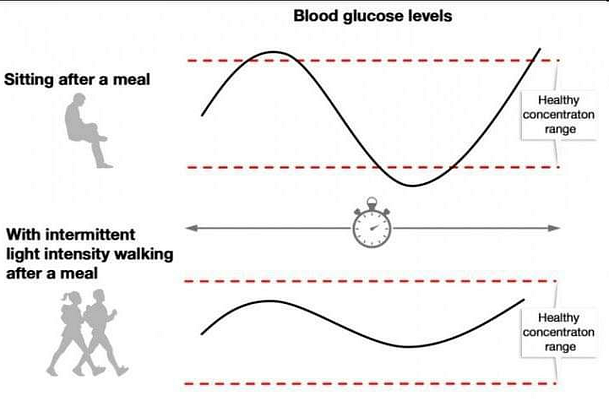
Just a 10–15 minute walk after eating is enough to significantly reduce glucose spikes and lower risks. Our muscles act as a buffer that can absorb excess fats and glucose. The problem is that when we sit or lie down, our major muscles are not active.
Even moderate physical activity increases the activity of the GLUT-4 transporter protein on the membranes of skeletal muscles, which further stimulates glucose uptake from the blood. By the way, walking before a meal does not have the same effect on glucose levels.
The more food you have eaten and the more carbohydrates, the longer the walk should be. Scientists have shown that three 15-minute walks after each meal significantly reduce the risk of developing diabetes compared to one 45-minute walk. Even a light walk is effective. If you really don’t have time, studies have shown that even working while standing is effective.
When you stand, the muscles that support your body are active — and 2 hours of standing work after eating reduces the peak glucose rise by 43%. Research has shown that half an hour of walking after a meal allows you to lose more weight than walking an hour later.
What does this mean?
Take a walk after eating or work while standing — it is a simple and effective way to smooth out glucose spikes (especially important to walk after dinner, as insulin sensitivity is lower in the evening).
You can use glucose monitoring to find the most effective time and speed for your walk.
Avoid prolonged sitting; any activity, even micro-breaks and small episodes of activity, help maintain normal glucose levels.
Three
15-min bouts of moderate postmeal walking significantly improve 24-h
glycemic control in older people at risk for impaired glucose tolerance.
Diabetes Care, 2013
Slow postmeal walking reduces postprandial glycemia in middle-aged women Appl Physiol Nutr Metab 2009 Dec;34(6):1087–92.
Standing-based
office work shows encouraging signs of attenuating post-prandial
glycaemic excursion Occupational and Environmental Medicine
2014;71:109–111.
Postprandial walking is better for lowering the
glycemic effect of dinner than pre-dinner exercise in type 2 diabetic
individuals J Am Med Dir Assoc 2009 Jul;10(6):394–7.